Lokale (europaspezifische) Inhalte: Wichtige Kennzahlen und Methoden zur Bewertung von Immobilieninvestitionen in Europa
Lernziele der Lektion:
- Understand Core Investment Metrics: Learn how to use Cashflow, Cap Rate, ROI, GRM, Und Bar-auf-Bargeld-Rückerstattung to measure a property’s Rentabilität, efficiency, Und investment potential.
- Learn How to Compare Investments: You’ll discover how tools like GRM help compare properties in markets like the Vereinigtes Königreich., and how metrics like Bar-auf-Bargeld-Rückerstattung support decision-making in places like Berlin oder Paris.
- Master Cash Flow Analysis in Europe: Understand how to calculate Gross Operating Income, Betriebskosten, Und Netto-Betriebsergebnis in European cities, and how to use these to assess whether a property will generate positive returns.
- Apply Metrics to Real-Life Scenarios: You’ll gain the skills to apply these formulas and concepts to evaluate and compare real properties in cities like Lisbon, Barcelona, Und Berlin, even when local market conditions vary.
23.1 Key Metrics and Methods for Evaluating Real Estate Investments in Europe
When investing in European real estate, there are specific key metrics to consider for evaluating the profitability of a property. These include:
- Cashflow: Calculated by subtracting all property-related expenses (e.g., maintenance, taxes) from rental income. European countries, like Deutschland oder Frankreich, may have different rental yields depending on local regulations and market conditions.
- Cap Rate: The capitalization rate in Europe is widely used to measure the return on a property, considering the local real estate market. For instance, in Deutschland, investors may find lower cap rates due to higher property prices compared to southern European countries like Spanien oder Portugal.
- Return on Investment (ROI): This metric calculates the total return from the investment, accounting for cash flow, property appreciation, and tax benefits in European countries. Frankreich Und Italien offer tax deductions that can improve ROI for property investors.
Key Methods:
- Gross Rent Multiplier (GRM): Used in many European markets, GRM is calculated as the property price divided by gross rental income. In markets like Großbritannien., GRM helps compare properties with different price points.
- Bar-auf-Bargeld-Rückerstattung: This is often used by investors in European cities like Berlin Und Paris to assess the annual return relative to the actual cash invested.
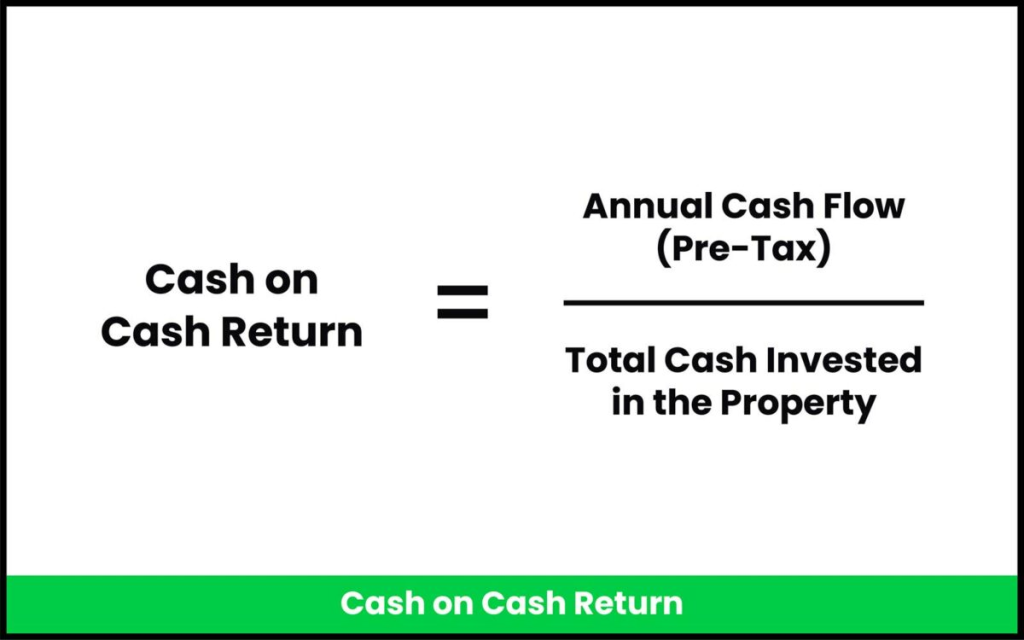
Figur: Cash-on-Cash-Renditeformel
Beschreibung:
Die Abbildung zeigt eine Formel zur Berechnung der Kapitalrendite (Cash-on-Cash-Rendite) bei Immobilieninvestitionen. Die Formel wird dargestellt, da sie Anlegern hilft, die jährliche Rendite ihres in eine Immobilie investierten Kapitals zu ermitteln, wobei Steuern unberücksichtigt bleiben.
Die zentralen Thesen:
- Jährlicher Cashflow (vor Steuern): Dies stellt das jährliche Einkommen dar, das aus der Immobilie vor Berücksichtigung der Steuern erzielt wird.
- Insgesamt in die Immobilie investiertes Bargeld: This is the total amount of money the investor has put into the property, including down payments, renovations, and other initial costs.
- Bar-auf-Bargeld-Rückerstattung: Diese Kennzahl liefert Anlegern einen Prozentsatz, der die jährliche Rendite ihrer Baranlage angibt.
Anwendung der Informationen:
The Cash on Cash Return is a crucial metric for real estate investors as it provides a clear picture of the profitability of their investment in relation to the cash they have invested. It allows investors to compare the performance of different properties and helps in making informed investment decisions. By understanding this metric, investors can better gauge the efficiency of their investment and its potential for generating positive cash flow.
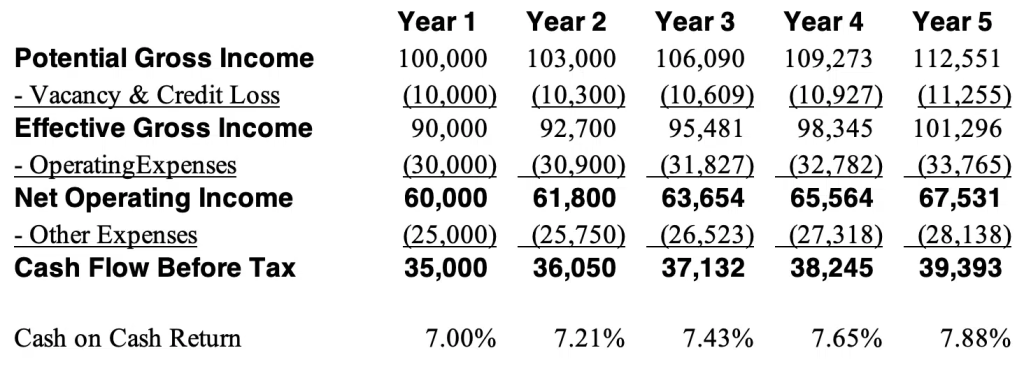
Figur: Berechnung der Cash-on-Cash-Rendite für eine Investition von 1.400.500.000
Beschreibung:
The graph illustrates the step-by-step calculation of the Cash on Cash Return for a real estate investment of $500,000. The process is as follows:
- Potenzielles Bruttoeinkommen (PGI): Dies stellt das Gesamteinkommen dar, das die Immobilie ohne Berücksichtigung von Verlusten oder Ausgaben generieren könnte.
- Abzug für Leerstand und Kreditverluste: Vom Bruttoeinkommen werden etwaige Verluste aufgrund leerstehender Einheiten oder Kreditausfälle abgezogen. Dies ergibt eine realistischere Einkommenszahl, die potenzielle Leerstände oder Zahlungsausfälle berücksichtigt.
- Effektives Bruttoeinkommen (EGI): Nach Berücksichtigung von Leerstand und Kreditausfällen erhalten wir den EGI, der das Einkommenspotenzial der Immobilie genauer widerspiegelt.
- Abzugsfähigkeit der Betriebskosten: Vom Bruttoeinkommen werden alle Betriebskosten abgezogen, die mit der Instandhaltung und dem Betrieb der Immobilie verbunden sind. Dazu gehören Kosten wie Instandhaltung, Hausverwaltungsgebühren, Nebenkosten und mehr.
- Netto-Betriebsergebnis (NOI): Nach Abzug der Betriebskosten vom Bruttoeinkommen (EGI) erhalten wir das Netto-Betriebsergebnis (NOI). Dieses stellt die aus der Immobilie generierten Einnahmen nach Abzug aller Betriebskosten, aber vor Finanzierungs- oder Kapitalaufwendungen dar.
- Abzugsfähigkeit sonstiger Ausgaben: Vom Netto-Betriebsergebnis werden andere Ausgaben wie Hypothekenzahlungen, Investitionsausgaben oder sonstige finanzielle Verpflichtungen abgezogen.
- Cashflow vor Steuern (CFBT): Nach Berücksichtigung aller Kosten erhalten wir den CFBT, der den tatsächlichen Cashflow darstellt, den ein Investor vor Berücksichtigung der Steuern erwarten kann.
- Berechnung der Cash-on-Cash-Rendite: Schließlich wird der CFBT durch den anfänglichen Investitionsbetrag ($500.000) geteilt, um die Cash-on-Cash-Rendite zu berechnen. Diese Kennzahl gibt den prozentualen Jahresertrag der Barinvestition an.
Die zentralen Thesen:
- Die Cash-on-Cash-Rendite vermittelt ein klares Bild von der Rentabilität einer Immobilieninvestition im Verhältnis zum eingesetzten Kapital.
- Dabei werden potenzielle Einnahmen, Betriebskosten und sonstige finanzielle Verpflichtungen berücksichtigt, um eine realistische Renditeangabe zu erhalten.
- Diese Kennzahl ist für Investoren von entscheidender Bedeutung, um die Effizienz ihrer Investition und ihr Potenzial zur Generierung eines positiven Cashflows einzuschätzen.
Anwendung der Informationen:
Understanding the Cash on Cash Return is vital for real estate investors. It allows them to assess the performance of their investment, compare different investment opportunities, and make informed decisions. By following the steps outlined in the graph, investors can get a clear picture of the potential returns and risks associated with a property.
23.3 Analyzing Cash Flow in Europe
Introduction: What is Cash Flow?
In Europe, cash flow refers to the net income after all property-related expenses are deducted from rental income. Positive cash flow indicates profitability, while negative cash flow suggests that the property costs more to maintain than it earns.
Wichtige Kennzahlen und Berechnungen
- Gross Operating Income (GOI): Total rental income minus vacancy losses in European cities with seasonal fluctuations, like Lisbon oder Paris.
- Betriebskosten: Include taxes, management fees, and local maintenance costs, which can vary widely across European countries.
- Net Operating Income (NOI): This is the GOI minus operating expenses. The NOI is critical for determining the profitability of a property in cities like Berlin, where property management costs may be higher.
Analyse des Cashflows
- Compare Cash Flow to Investment: In markets like Paris oder Barcelona, where property prices are high, understanding cash flow in relation to the initial investment is crucial.
- Bar-auf-Bargeld-Rückerstattung: This metric is helpful in European markets where financing terms differ across countries. It helps compare the yield from cash invested.
Wichtige Unterrichtsinformationen:
- Cashflow is one of the most important metrics for investors. It measures the Nettoeinkommen a property generates after all Kosten are deducted from rental income. A property with positive cash flow earns more than it costs to maintain, while negative cash flow signals a potential loss.
- Cap Rate, or capitalization rate, helps investors estimate the rate of return based on a property’s income and purchase price. In countries like Deutschland, where property prices are high, cap rates tend to be lower, while places like Spain or Portugal may offer higher returns.
- Return on Investment (ROI) beinhaltet cash flow, appreciation, and tax benefits to give a complete picture of the investment’s profitability. Countries such as Frankreich Und Italien provide tax deductions that can increase ROI for real estate investors.
- Gross Rent Multiplier (GRM) is a quick comparison tool used in markets like the Vereinigtes Königreich.. It divides the property price by gross rental income, allowing investors to evaluate which properties offer more income for the price.
- Bar-auf-Bargeld-Rückerstattung shows the annual return you earn based on the cash you invested (excluding loans). It’s especially useful in cities like Paris Und Berlin, where financing terms may vary, and helps you compare the efficiency of your investments.
Schlusserklärung:
Being able to evaluate real estate investments with the right financial metrics gives you a strong advantage as an investor. These tools help you compare opportunities, estimate returns, and reduce risks, especially when investing across different European countries with unique market conditions.

 DE
DE  EN
EN  PT
PT  SW
SW  ML
ML  AR
AR  ZH
ZH  ES
ES  EL
EL  ES_ES
ES_ES  FR
FR  HI
HI  IT
IT  JA
JA  KO
KO  PT_PT
PT_PT  PL
PL  LT
LT  UK
UK  KA
KA  DE_AT
DE_AT  NB
NB  NN
NN